Economic analysis and insights to guide housing strategies

Thrive Economics studies how housing markets respond to zoning, taxes, and public financing, and helps governments and advocates use that evidence to design policy.

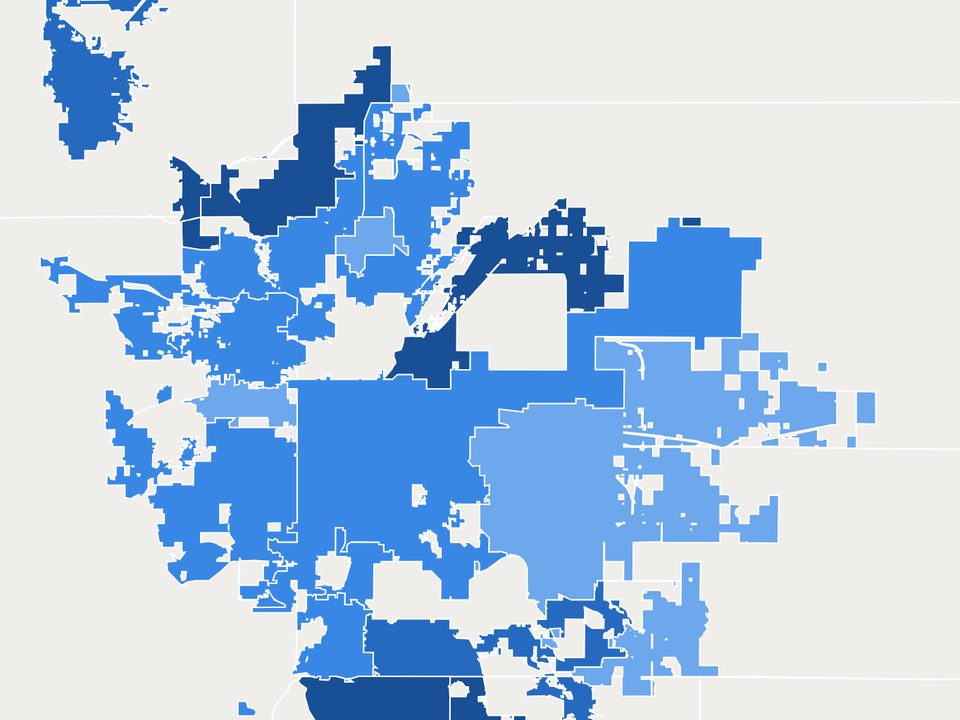
Map of Denver-area cities shaded by the AMI level that matches each city's median 2-bedroom rent Colorado market rents in AMI terms An interactive map and table of the median rent in 42 Colorado communities, expressed as the AMI level whose maximum rent matches it.

New lenses. Better levers.

Luke Teater

Luke Teater is a housing economist and the principal of Thrive Economics. He combines policy analysis with economic, demographic, and administrative data to study housing supply and affordability, and the regulations, taxes, and financing that shape local housing markets.

Luke helped design the financing programs in Colorado's Proposition 123. They direct state dollars to the gaps in a project's capital stack, where a smaller public investment can bring in private capital. In their first two years, those programs leveraged state funds at nearly 8 to 1, supporting $2.3 billion in total housing investment and financing more than 7,200 new affordable homes.

Previously, Luke was Chief Economist and Deputy Director for Tax and Economic Development at the Colorado Office of State Planning and Budgeting under Governor Polis. He led the state's quarterly economic and revenue forecasts, chaired the Governor's Revenue and Economic Advisory Committee, and advised on major fiscal and economic policy, including Colorado's COVID-19 economic response. Before joining state government, he analyzed credit risk and subsidy costs for federal lending programs in housing and economic development for clients including HUD, FHFA, and the Department of Energy. He also led an engagement at the U.S. Treasury forecasting all federal revenues, expenditures, and financing needs during the 2012 debt limit negotiations. He lived in Kolkata, India, for three years, where he founded a social enterprise.

His research covers housing and land economics, real estate finance, zoning and land use, and property taxation. He works with academic researchers, policy organizations, and government agencies on research meant to inform housing policy debates.

Education

MBA, University of Colorado Boulder, Leeds School of Business
BA, University of North Carolina at Chapel Hill

Government experience

Five years in the Colorado Governor's Office, including as Chief Economist. Ten years consulting for federal, state, and local government agencies.

Services

Applied housing research and data analysis

Research on housing markets, rents, construction, and development feasibility, built on economic, demographic, and spatial data. Recent examples include a study of how Denver's construction boom affected rents and a map of Colorado rents in AMI terms.

Housing policy design

Legislation, ballot measures, and financing programs meant to expand housing supply, with support through drafting, negotiation, and implementation. Most of this work has been in affordable housing finance and zoning reform.

Land use and zoning reform

Analysis of how parking mandates, minimum lot sizes, density limits, and transit-oriented development standards affect what gets built. Luke coordinated the fundraising that brought the National Zoning Atlas to Colorado.

Land and property taxation

Research and policy work on land value taxation and split-rate property taxes. Taxing land more and buildings less rewards construction and returns to the public some of the land value that public investment creates.

Project feasibility and finance

Pro formas, capital stack design, and feasibility analysis for affordable, mixed-income, and market-rate housing. Experience with LIHTC, public equity, tax-exempt bonds, and less conventional deal structures, including testing how a project holds up under different policies, markets, and financing terms.

Speaking and testimony

Testimony, conference talks, panels, and briefings. Luke has presented to legislative committees and the Colorado Commission on Property Tax, at industry conferences, and to advocacy groups and reporters.

Selected work

ResearchDU and Terner Labs

Parking Minimums and Housing Production in Denver

Coordinated the first use of Terner Labs' Housing Policy Simulator in Denver, working with Terner Labs, DU faculty at the Burns School, RMLUI, and the Scrivner Institute, and local developers to check the model's assumptions. The co-authored white paper estimated that eliminating parking minimums would add roughly 460 homes a year in Denver under tougher economic conditions, about a 12.5 percent increase. Denver eliminated parking minimums the following month.

Policy researchSchalkenbach Foundation

Primer on Land Value Tax for the Colorado Commission on Property Tax

Analysis of how shifting from traditional property taxes to land value taxation would affect development incentives, residential tax bills, and rents in Colorado. Co-authored with Stephen Hoskins at the Progress and Poverty Institute.

Policy designState of Colorado

Colorado Proposition 123

Co-authored and helped design the 2022 ballot measure that created a dedicated state funding stream for affordable housing. Its programs include a state equity investment fund, a Tenant Equity Vehicle, and tools to expand modular construction, speed up permitting, and encourage local land use reform.

AdvisoryVarious clients

Additional projects

Fundraising and development coordination for the Colorado Zoning Atlas. MIHA project financing and capital stack design. Denver Measure 2R advisory. YIGBY project feasibility modeling. Denver housing needs estimates and affordable housing strategy. Revolving construction loan fund design. Development feasibility analysis for statewide land use legislation.

Recent publications and talks

A selection of recent reports, articles, and presentations. Shorter pieces go out through the newsletter.

2026Interactive map and data
2026Housing Forward Colorado
2025RMLUI white paper
2025

Data Frontiers: Emerging Tools to Support Policy Development

RMLUI Conference
2025

Land Value Taxes: Turning Property Taxes into a Tool for Reinvestment

YIMBY Denver and PPI
2024

Financing Housing to Create Access

RMLUI Conference

Contact

Thrive Economics takes on research, analysis, and policy design projects for state and local governments, research institutions, foundations, advocacy organizations, and mission-aligned private clients. Email is the best way to get in touch.

LocationDenver, Colorado

Member of the American Economic Association, the National Association for Business Economics, the Denver Association of Business Economists, and ULI Colorado.